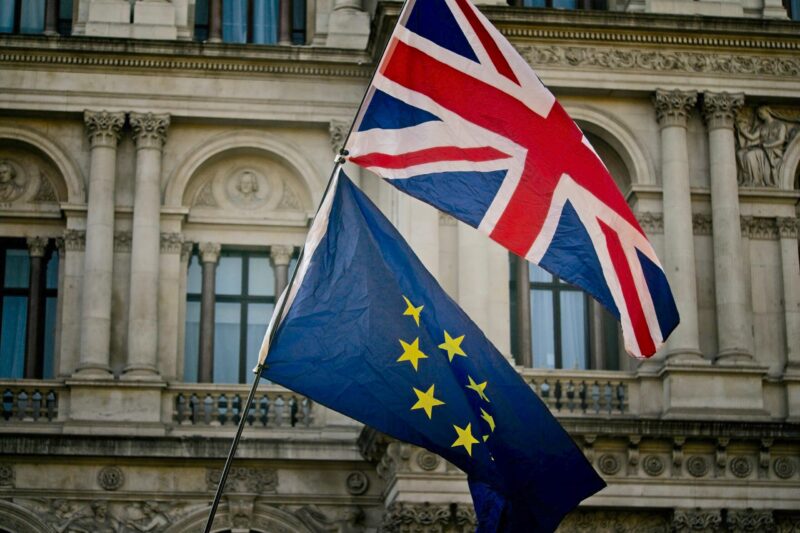
Northern Ireland, part of the United Kingdom and occupying the northern six counties of the island of Ireland, shares a land border and a long history with the Republic of Ireland to its south. Decades of violence and political strife between the two principal groups in Northern Ireland – the Nationalist, largely Catholic minority, and the Unionist, largely Protestant majority – were brought to an end with the signing of the Good Friday Agreement in 1998. This Agreement has been the basis for peace in Northern Ireland for the past two decades, but Brexit has tested it to its limits, and with the election of a new Conservative Prime Minister later this year, many now fear for the Agreement’s future.
Though it was not often discussed in the lead-up to the Brexit referendum in 2016, the border between Northern Ireland and the Republic of Ireland has been the biggest source of strife in the years following the U.K.’s decision to leave the European Union. During the period of conflict and violence in Northern Ireland referred to as the Troubles, a heavily fortified border was maintained between north and south. This border was often the site of dissident attacks and became a symbol of the discord in the region.
Although it did not specifically denounce a hard border between north and south, the Good Friday Agreement led to the deconstruction of the heavily fortified border, and in its absence, Northern Ireland’s relations both internally and with its neighbours greatly improved. Additionally, as both the Republic and the U.K. were members of the E.U., which allows for free cross-border travel, in 1998, the open border followed standard European practices and was not as contentious an issue as it is now.
With the U.K. officially out of the E.U., goods travelling between north and south are now subject to different rules and standards. The lack of a suitable trade agreement between the U.K. and E.U. necessitates the introduction of checkpoints to ensure that goods entering the E.U. complied with European standards. However, the location of these checkpoints has been in dispute since they were proposed. Both the E.U. and the Republic of Ireland refuse to accept a hard land border between north and south – a view which the vast majority of Northern Irish political parties supports, as it could lead to a return to hostilities. Instead these parties have backed a border across the Irish Sea, implemented at Northern Irish ports.
The Conservative-led U.K., meanwhile, opposes this view. Supporting this opposition is the Democratic Unionist Party (D.U.P.), a hard-line Unionist group, and until recently the largest political group in the Northern Irish Assembly, which states that a sea border in effect separates Northern Ireland from the U.K. and goes against the Good Friday Agreement. These parties believe that the necessary goods checks could be conducted “in market” at warehouses and distribution points, negating the need for either proposed border. However, critics have pointed out the difficulties in regulating this proposal, as well as its lack of transparency. The “in market” proposal could also contribute to an increase in cross-border smuggling, which the Republic and the E.U. are keen to avoid.
The issue of the border checkpoints has led to the suspension of the Northern Irish Assembly, as every single Unionist has refused to accept the current protocol. No business can be conducted in Northern Ireland without the necessary power-sharing stipulated in the Good Friday Agreement, and the longer this issue continues, the more serious it becomes.
Prime Minister Boris Johnson signed the Northern Ireland Protocol agreeing to the Irish Sea border checkpoints in October 2019. However, he has done much to undermine this agreement in the years since. In July 2021, Johnson asked Lord Frost to draft the Northern Ireland Protocol Bill, which seeks to give U.K. ministers sweeping powers to unilaterally change the protocol – to the outrage of the Republic of Ireland and the E.U. Crucially, the bill would create “lanes,” red and green, through which goods could enter Northern Ireland. Green goods would remain in Northern Ireland and would not be subject to checks, whilst goods in the red lanes would travel south and undergo the necessary checks as they passed through the border. If passed, the Northern Ireland Protocol Bill would in many ways override the Northern Ireland Protocol, which is part of international law, and thus the E.U. has pursued legal action.
The U.K. has defended its actions, stating that it is allowed to change the terms of the agreement to “serve an essential interest,” namely the ongoing power-sharing crisis in Northern Ireland. Furthermore, the U.K. wants a separate independent body to settle the disagreement, not the European Court of Justice.
The E.U. has refused to allow the U.K. to renegotiate the Protocol, but is willing to compromise on how certain rules are applied. It is demanding a response within two months of June 15th, and if the U.K. fails to comply, many fear that a trade war could begin between the two.
Now that Boris Johnson has resigned as Prime Minister, it is up to the next Conservative Prime Minister to solve the issues left in his wake. Both potential candidates have largely avoided the question of Northern Ireland in public debates, though they share similar viewpoints in that they agree with Johnson’s desire to override the current Protocol with the Irish Sea Border. However, their responses are markedly different. Rishi Sunak acknowledges the difficulties inherent in the current protocol and wishes to negotiate a solution with the E.U. Sunak appears, to an extent, to want to heal the U.K.’s fractured relationship with the E.U.
His opponent Liz Truss stands in stark contrast, appearing, if anything, more antagonistic towards the E.U. than her predecessor. Truss was instrumental in drafting the Protocol Bill in what she termed “the face of E.U. intransigence.” She is prioritizing the D.U.P.’s desires over international law, wishing to restore power sharing in the north through a potentially hefty cost. If elected to power, Truss risks instigating a trade war and inciting discord in Northern Ireland, as every other major political party in the region staunchly opposes the Northern Ireland Bill.
Northern Ireland is a region with a long and often difficult history, and political leaders would do well to act sensitively when drafting legislation in its regard. Former Prime Minister Johnson’s disregard for international law and the peace accords that maintain stability in Northern Ireland has heightened tensions with Northern Ireland and its neighbours. It is up to the next Conservative leader and all relevant stakeholders to resolve the many issues in Northern Ireland in ways which don’t seek to antagonize or sow discord.
- 18 Dead In Malagasy Police Station Attack After Kidnap Of Child With Albinism - September 19, 2022
- Migrant Farmers In Canada Allege Inhumane Treatment; No Proof, Says Labour Minister - September 12, 2022
- Sorcery Accusations In Papua New Guinea On The Rise - September 11, 2022