
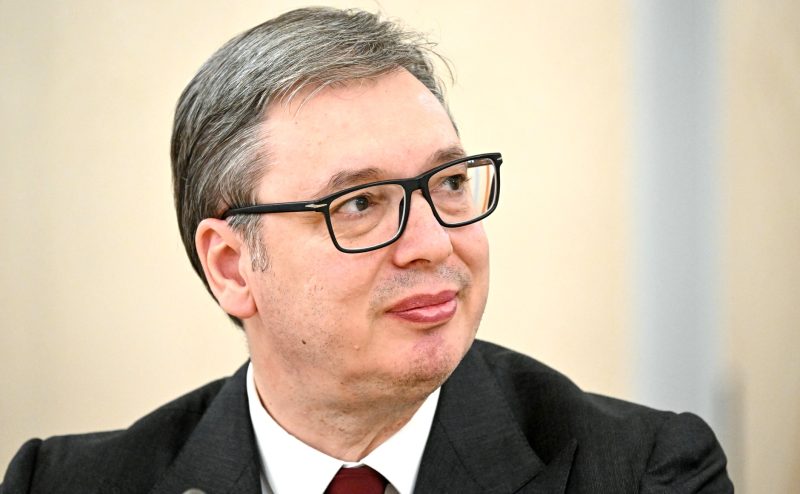
Protests in Belgrade have not ceased since the collapse of the Novi Sad station roof on November 1, 2024. The incident came to embody the corruption and mismanagement of the Serbian government, led by President Aleksandar Vučić, who has dominated Serbian politics since 2014. In its wake, a broad civic movement, mainly composed of students and teachers, including some who lost relatives in the Novi Sad tragedy, has mobilized, determined to confront the country’s democratic backsliding with the strength that arises only when political and civil rights are visibly eroded.
Even before this, in 2023, demonstrations had erupted following flawed parliamentary elections, which resulted in the Serbian Progressive Party (S.N.S.) taking control of parliament. Officially, the S.N.S. secured 46% of the vote, thereby gaining a majority of seats. However, several institutions, including the European Parliament, denounced serious irregularities, such as breaches of ballot secrecy and voter registration manipulation.
According to Freedom House statistics, Serbia’s democratic stability has been at risk for several years. The country is classified as “partly free,” a judgment based not only on recent electoral manipulation but also on the lack of political pluralism and participation, as well as high levels of government corruption.
In recent years, this erosion of freedom has fueled growing discontent and anger among the Serbian population, channeled into protests both at home and abroad. The resilience of Vučić’s rule, tellingly, rests not only on internal political dynamics but also on the leverage of powerful external actors, particularly the European Union (E.U.) and Russia.
Despite condemning the 2023 elections, the E.U. has not taken a clear or active stance against Vučić’s rule. On the contrary, it has pursued a policy aimed at safeguarding regional stability and keeping Serbia closely tied to the Union, mindful of both Russia’s influence in the Balkans and the destabilizing potential of unresolved issues such as the status of Kosovo. Within this strategy, agreements like the 2024 Memorandum of Understanding on Sustainable Raw Materials, which foresees the exploitation of jadarite deposits in western Serbia, have been seen by parts of the Serbian public as emblematic of a broader trade-off: political support in exchange for economic concessions.
In this sense, E.U. engagement has been interpreted by protesters not as a defense of democratic standards but as a pragmatic deal that overlooks Serbia’s democratic decline in the name of stability. Although Brussels had once promoted reforms aimed at strengthening the rule of law and democracy as part of Serbia’s accession process, these efforts produced little substantive change and were gradually sidelined. Into this gap stepped Vučić, whose hallmark in recent years has been a policy of “equidistance” between Moscow and Brussels, seeking to keep both sides as partners. Serbia’s stance on the war in Ukraine exemplifies this balancing act: while refusing to join E.U. sanctions against Russia, Belgrade nonetheless voted in favor of U.N. resolutions condemning Moscow’s aggression.
E.U. policy has thus been increasingly driven by the imperative of maintaining regional stability and preventing Serbia from drifting into Russia’s sphere of influence. In this context, Vučić, acting as mediator and indispensable ally willing to partially accommodate European interests, has become the cornerstone of this stability.
The unresolved conflict with Kosovo further complicates Serbia’s European relations, once again reinforcing Vučić’s leadership. Since Kosovo’s unilateral declaration of independence, which Serbia has never recognized, negotiations aimed at reconciling the two sides have been the main determinant of E.U. policy toward Belgrade. The Brussels Agreement of 2013, brokered by the E.U., called for the establishment of an Association of Serb-majority municipalities in northern Kosovo (Mitrovica North, Zvečan, Zubin Potok, and Leposavić). As part of the deal, both sides committed not to obstruct each other’s E.U. accession paths.
At the time, the agreement appeared to be a promising foundation for resolving disputes. The E.U. positioned itself as mediator, and Vučić emerged as the leader most capable of advancing this process. Yet the provisions laid out in the agreement were never fully implemented. In practice, the main beneficiary was Vučić himself. By aligning Serbia with Europe’s overriding concern for stability, he has steadily eroded democracy at home, consolidating what is increasingly described as a form of competitive authoritarianism.
The paradox of this situation is becoming increasingly evident. By privileging stability over democracy, the European Union risks fueling popular discontent, pushing Serbia further away from its sphere of influence, and ultimately laying the groundwork for the very instability it seeks to prevent.
A recalibration of conditionality is therefore required. E.U. concessions, whether in the form of financial assistance or progress in accession negotiations, should be tied to substantive democratic progress rather than to formal commitments alone. Observers such as Freedom House and Amnesty International have repeatedly documented the erosion of media freedom, the lack of judicial independence, and the repression of dissent.
Addressing these deficiencies demands a shift from exclusive reliance on elite-level negotiations to more direct support for democratic actors, including independent media outlets, civil society organizations, and protest movements that articulate citizens’ demands. In addition, greater transparency in the allocation and monitoring of E.U. funds in Serbia would help prevent the misuse of European resources to reinforce clientelistic networks and authoritarian resilience.
So far, however, the Union has confined itself to symbolic gestures, without ever directly confronting Vučić or imposing meaningful political costs on his government. To genuinely promote democracy in Serbia, the E.U. must move beyond rhetorical commitments, make more assertive use of its accession leverage, and ensure that its policies reflect the values it professes to uphold. Only by embedding conditionality in tangible democratic outcomes can the Union counter the current trend of competitive authoritarianism and restore credibility to its enlargement strategy.
- Copenhagen Summit: The European “Drone Wall” Project - October 14, 2025
- Sudan: From The 2021 Coup To A Nationwide War - October 14, 2025
- Global Sumud Flotilla: What International Law Says - October 14, 2025