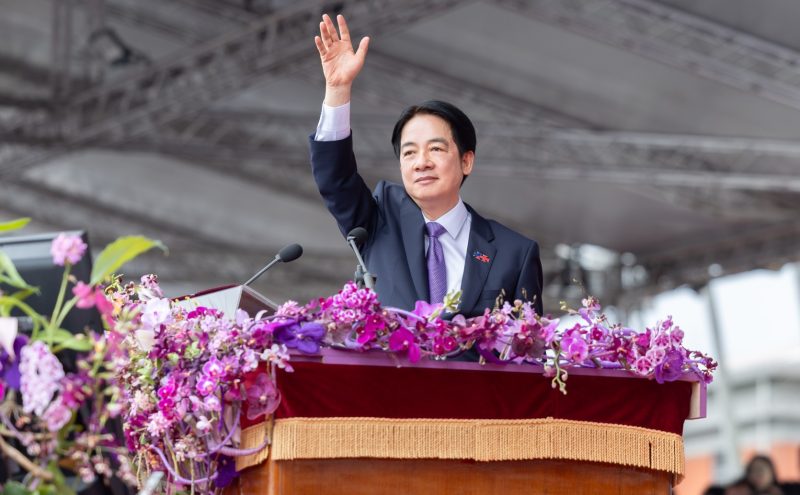
Taiwan’s President Lai Ching-te recently arrived in Eswatini on an unannounced visit, just weeks after his government was forced to postpone the trip due to what was referred to as Chinese-pressured airspace bans by Indian Ocean nations, as reported by Reuters. The surprise trip, which was not announced in advance by either government, followed “days of careful arrangements by the diplomatic and national security teams,” Lai said in statements obtained by the BBC, though he did not disclose exactly how he reached the southern African nation. According to reports from both Reuters and the BBC, Eswatini—formerly known as Swaziland—is Taiwan’s sole remaining diplomatic ally in Africa. It is one of just 12 nations globally that maintain formal diplomatic ties with the democratically self-ruled island, which China claims as its own territory with no right to state-to-state relations.
Reuters journalist Ben Blanchard reports that Lai’s trip was originally scheduled for late April to mark the 40th anniversary of the accession of Eswatini’s King Mswati III. However, according to Taiwanese government statements cited by Reuters, those plans were suspended after Seychelles, Mauritius, and Madagascar unilaterally revoked flight permits for Lai’s aircraft due to intense diplomatic pressure from Beijing. An analysis shared by Reuters noted that this was the first time a Taiwanese president had to cancel an international trip due to denied airspace access, representing what experts view as a new Chinese strategy to further isolate Taiwan on the global stage.
According to social media posts on Lai’s official Facebook and X accounts, the president bypassed those restrictions to arrive on Saturday. While official statements did not detail his flight path, Reuters reports that Lai shared a photograph of himself stepping off what appeared to be an Eswatini government jet. According to Taiwanese officials, this same aircraft had brought Eswatini’s Deputy Prime Minister Thulisile Dladla to Taipei earlier in the week. “Taiwan will never be deterred by external pressures,” Lai wrote on social media, in posts highlighted by both news outlets. “Our resolve & commitment are underpinned by the understanding that Taiwan will continue to engage with the world—no matter the challenges faced.” According to images and details published by the BBC, President Lai was seen high-fiving Taiwanese compatriots upon arrival and was formally welcomed by Eswatini Prime Minister Russell Dlamini alongside a guard of honor. A memorandum from the Taiwanese presidential office, cited by the BBC, confirmed that the traveling delegation also includes Foreign Minister Lin Chia-lung and National Security Council Adviser Alex Huang.
The BBC reports that Lai’s official itinerary in Eswatini includes bilateral talks with King Mswati III and the signing of a bilateral customs agreement. Lai also released a statement praising Eswatini for “standing firm against various diplomatic and economic pressure, speaking out for Taiwan’s international place through concrete actions.” In statements obtained by the BBC, a U.S. State Department spokesperson defended the trip as “routine” and urged that it “should not be politicized.” The spokesperson added that “every democratically elected Taiwan president has made an overseas trip to visit Taiwan’s diplomatic partners,” pointing to Lai’s predecessor, Tsai Ing-wen, who visited Eswatini in 2018 and 2023.
Lai’s initially cancelled travel plans had also prompted criticism of Beijing from the U.S. and official concern from the European Union, Britain, France, and Germany, according to Reuters. Following the visit, China’s Foreign Ministry reacted with fierce criticism. In statements released to both Reuters and the BBC, Beijing described the unannounced trip as a “stowaway-style escape farce” and claimed Lai had “secretly slipped aboard a foreign aircraft and sneaked out of Taiwan, lavishly squandering public funds.” “No matter how the Democratic Progressive Party authorities collude with external forces or in what form they ‘buy the loyalty of others,’ it is all a futile effort that cannot change the fact that Taiwan is part of China,” the ministry said in an official statement referring to Lai’s ruling party. According to the BBC’s monitoring of Beijing’s official briefings, China’s foreign ministry added that Lai had made himself “an international laughing stock” and urged Eswatini “to see clearly the general trend of history” rather than “pull chestnuts out of the fire.” The geopolitical tension has also translated into economic measures, with the BBC reporting that China had scrapped tariffs for all African nations with the sole exception of Eswatini.