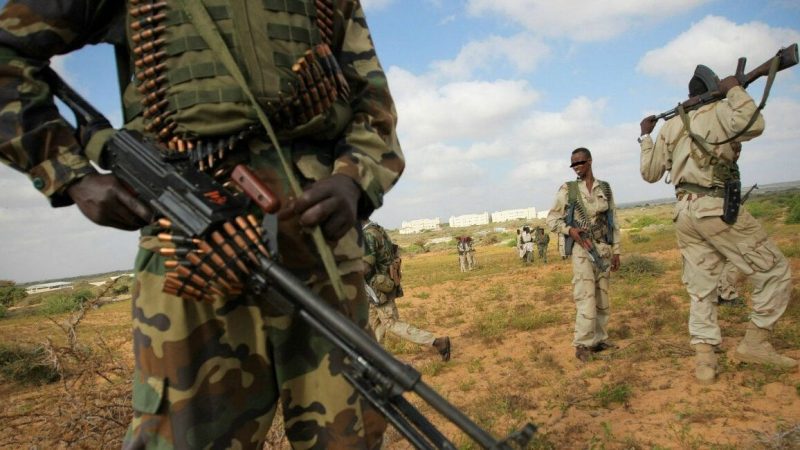
This past March, hundreds of Kenyans gathered in Nairobi to protest for the release of over 1,000 Kenyan nationals, many of whom were relatives lured to fight for the Russian military. According to Al Jazeera, many returnees and families of those still fighting said they were tricked into joining the war on Russia’s side. They originally thought they would work regular service jobs for higher wages than they could earn in Kenya. Instead, many were sent as soldiers to the front lines of the Russo-Ukrainian War, forcing them to become pawns in a political battle as their desperation for higher income left them trapped and vulnerable to exploitation.
In a report to Oregon Public Broadcasting (O.P.B.), several Kenyans have had their lives put at risk in the process, with dozens being arrested as prisoners of war. This includes one Kenyan named Dennis Bagaka Ombwori. His brother, Alfred Morara, said the news had shattered the family. He told O.P.B. that, “They were not told which job they wanted to do.” Returnees detail similar experiences to N.P.R., stating that they were promised skilled jobs, such as electrical and plumbing positions. Several politicians have spoken out against what they deem a network of “collusion” that is feeding Russia more Kenyans as soldiers. Parliament majority leader Kimani Ichung’wah revealed that certain state officials are secretly collaborating with recruiters from human trafficking syndicates, rogue Kenyan airport staff, and immigration officers, as a way to transport Kenyans to fight. However, the Russian embassy in Nairobi has dismissed the allegations as “dangerous and misleading,” saying that its staff have never engaged in illegal enlistment.
These developments stem from an increasing entanglement with Russia that has enabled its influence to exploit the nation’s most vulnerable. Russia has a strong interest in Kenya, particularly in trade and development cooperation, and has pursued substantial foreign direct investment in Kenya’s economic sectors. According to the Kenyan Institute for Public Policy Research and Analysis (K.I.P.P.A.), bilateral trade between Russia and Kenya totaled 48.13 billion Kenyan shillings in 2021. In 2019, the two countries met in Sochi to discuss potential trade agreements, though these have not been formalized. However, several partnerships with universities, pharmaceutical companies, and the energy sector have intertwined the two countries in their financial and human capital. Russia plays a dominant role as a leading hegemon in the global world order, while Kenya stands as a lower-middle-income country that has faced political destabilization and colonialism. Due to its immense power in the world order and its realist approach to international politics, Russia sees no need to limit itself ethically to protect the most vulnerable. As a result, Russia continues to abuse Kenya’s status and civilians’ desperation to meet its strategic interests in winning the war while suffering no legal consequences.
Many advocates have stated that it is critical for Kenya to break its ties with Russia to protect its citizens’ security. K.I.P.P.A. suggests that Kenya could source its wheat products from other top exporters, such as India, Australia, and countries in the European Union, to bridge the gap left by severing ties with Russia. Additionally, the Associated Press reports that the families petitioning Parliament said recruiters operating in the country must be prosecuted for possible violations of international labor laws in order to cement the rule of law and show that it still applies to those who take advantage of the powerless. Ultimately, unless Kenya strengthens accountability at home and reevaluates its international partnerships, vulnerable citizens will remain at risk of being drawn into conflicts that have little to do with their own nation’s interests.
Latest posts by Evan Kwiatkowski (see all)